

Grey fleet: what employers need to check when staff drive their own cars for work
October 5th 2026
If anyone in your business drives their own car to visit a client, a supplier or another site, you run a grey fleet. Many businesses do, often without calling it that. It feels low-maintenance because the business doesn't own the cars, but the legal duties around work driving still sit with the employer.
This guide covers what the law expects, the insurance and paperwork to check, what to pay per mile now that HMRC's approved rate has gone up to 55p, and when it makes more sense to stop relying on staff cars.
What is a grey fleet?
A grey fleet is any vehicle owned by an employee and used for business journeys. The Health and Safety Executive (HSE) describes it simply: "A grey fleet vehicle is owned and driven by a worker for business purposes." The term usually covers privately owned cars, but it can include vehicles on a personal lease or finance agreement too, because the business still doesn't own or provide them.
Typical grey fleet journeys include sales visits, travel between branches, site inspections, training days at another location and trips to the bank or post office. Driving from home to a normal place of work isn't counted as business travel for tax purposes; we cover that in the mileage section below.
Are employers responsible when staff use their own cars for work?
Yes. HSE guidance is clear that "the law applies to both company and grey fleet vehicles", and that "health and safety law applies to work activities on the road in the same way as it does on a fixed site" (HSE, driving and riding safely for work). That means work driving should be part of your risk assessment, looking at the journey, the driver and the vehicle.
There is a motoring law angle as well. Under section 143 of the Road Traffic Act 1988, a person must not "cause or permit any other person to use a motor vehicle" on a road without valid insurance for that use. If you ask an employee to make a business journey in a car that isn't insured for it, the business could be exposed, not only the driver.
Work driving carries real risk. The Department for Transport's latest figures, published on 30 July 2026, estimate that 445 people were killed in collisions involving someone driving for work in 2025, 29% of all road deaths in Great Britain (DfT, reported road casualties involving driving for work).
Do employees need business use insurance to drive for work?
Personal car insurance is often limited to social, domestic and pleasure use, sometimes with commuting to a fixed place of work added, so business journeys may not be included. Travelling to different sites, meeting clients or running business errands generally needs business use to be included on the policy, as AMT Insurance Solutions explains on its company car and van insurance page.
Insurers describe the levels of business use in different ways. Some use numbered classes, some cover the policyholder only, and some extend business use to a named spouse or partner. The wording on the driver's certificate of motor insurance and policy schedule is what counts, so the practical step for an employer is to see that wording rather than take a verbal "yes, I'm covered".
Two points often catch people out:
Commuting is not the same as business use. A policy that includes commuting may still exclude a trip from the office to a client's premises.
Cover can lapse or change at renewal. An employee might switch insurer to save money and drop business use without realising it matters. That's why checks need repeating, not just doing once.
Whether a particular policy is right for a particular driver is a question for that driver and their insurer or broker. Your role as the employer is to confirm that suitable cover is in place before the car is used for work.
What checks should employers make on grey fleet drivers?
A short, consistent set of checks covers most of the risk. Before someone drives their own car for work, and again at regular intervals, ask for:
Driving licence. Employees can generate a check code through GOV.UK's view or share your driving licence information service. It shows licence categories, penalty points and any disqualifications, and the code is valid for 21 days.
Insurance. A copy of the current certificate or schedule showing business use, checked against the dates and the vehicle registration.
MOT. In Great Britain, cars over three years old need a current MOT certificate. You can confirm MOT status online using the registration number.
Road tax. Confirm the vehicle is taxed. This now applies to electric cars as well as petrol and diesel.
Vehicle condition. A simple declaration that the car is roadworthy and serviced in line with the manufacturer's schedule, with a reminder to report anything that changes.
Set a review point that suits your business, for example every six or twelve months and whenever an employee changes car or insurer. Keep a record of what was checked and when. If something goes wrong, a record of consistent checks helps show the business took reasonable steps.
What mileage rate should you pay for grey fleet journeys?
HMRC's approved mileage allowance payment (AMAP) for cars and vans rose from 45p to 55p per business mile from 6 April 2026, the first increase in 15 years (GOV.UK, business travel mileage rules for tax; ICAEW, May 2026). The current approved rates are:
cars and vans: 55p per mile for the first 10,000 business miles in the tax year, then 25p per mile
motorcycles: 24p per mile
bicycles: 20p per mile
passengers: an extra 5p per passenger per mile when carrying colleagues on a work journey
If you pay up to the approved amount, you don't need to report it to HMRC or deduct tax. If you pay more, the excess goes on form P11D and is taxed as pay. If you pay less, the employee can claim Mileage Allowance Relief on the difference. These rates apply to business miles only: GOV.UK guidance on tax relief for vehicles excludes "travelling to and from your work, unless it's a temporary place of work".
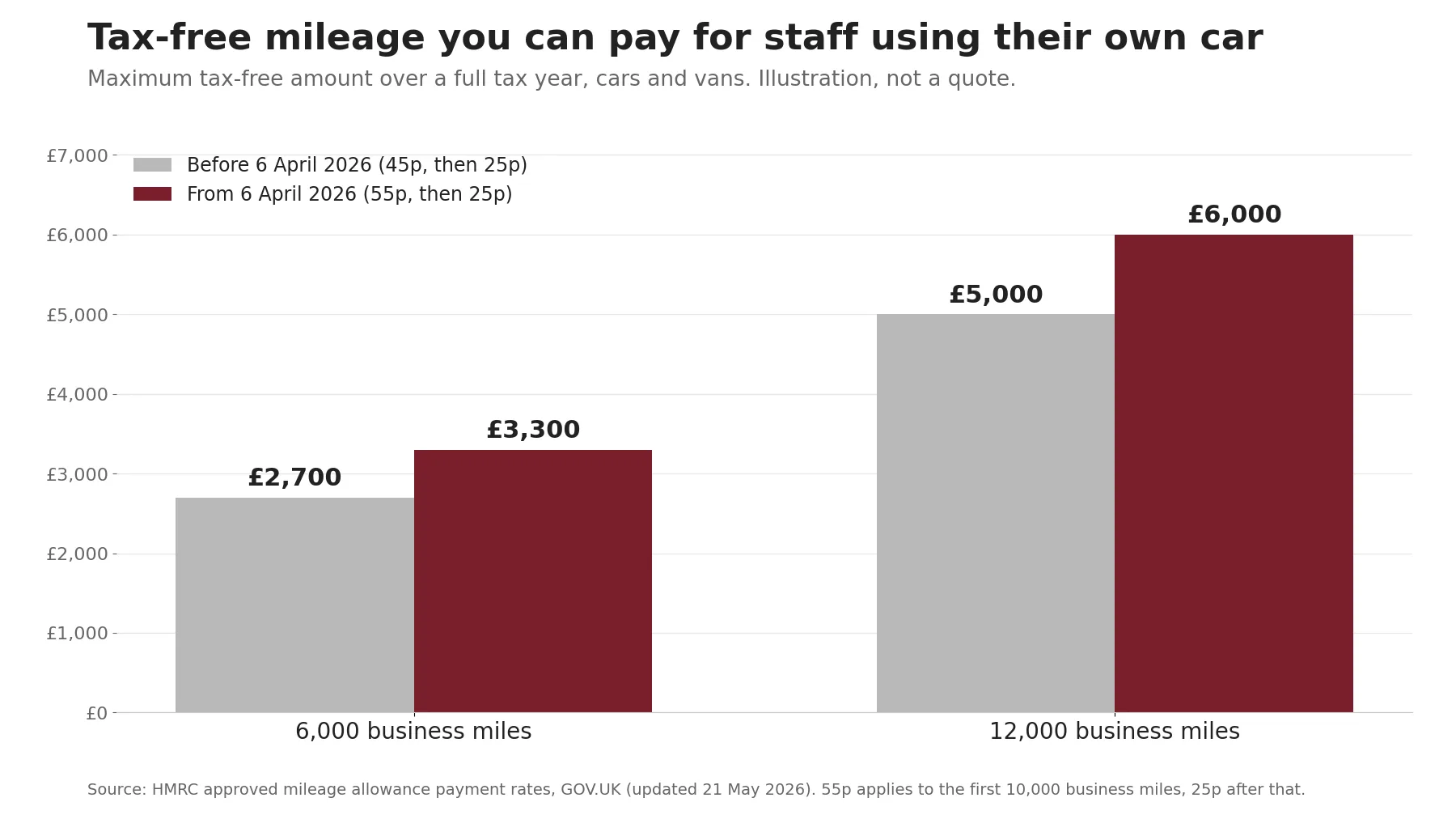
As a worked example, an employee who drives 6,000 business miles in their own car this tax year can now be paid up to £3,300 tax-free, compared with £2,700 at the old rate. At 12,000 business miles, the maximum is £6,000 (10,000 miles at 55p plus 2,000 miles at 25p), up from £5,000.
Where an expenses policy still pays 45p, staff can claim tax relief on the 10p gap, but only at their own tax rate, which is 2p a mile for a basic-rate taxpayer. And if a flat 45p is paid for every mile, anything above 25p after the first 10,000 business miles is taxable. Some employers choose to pay the full approved rate so staff with high business mileage aren't out of pocket.
What should a grey fleet policy include?
A written policy keeps everyone working to the same rules. It doesn't need to be long. A typical policy covers:
who is allowed to drive their own car for work, and any minimum standards for the vehicle
the documents employees must provide, and how often
the mileage rate the business pays and how to claim it
expectations on journey planning, rest breaks and not using a handheld phone while driving
what to do after a collision or breakdown on a business journey
when an employee should use a pool, hire or company vehicle instead
Ask employees to sign to confirm they've read it, and revisit it when the rules change, as they did with the mileage rate this year.
When does a grey fleet stop making sense?
Grey fleet works well for occasional, short business journeys. It gets harder to manage once mileage is high or journeys are long, or if staff cars aren't suitable for the job. The higher 55p rate also changes the sums, so for high-mileage roles it's worth comparing the annual mileage cost with the cost of providing a vehicle.
The alternatives depend on how the driving is spread:
Occasional long trips or short projects: a hire car means the journey is made in a vehicle supplied and maintained by the rental company, subject to the hire terms. AMT Auto's guide to renting a business fleet sets out how flexible rental works.
Regular high-mileage roles: business car leasing can provide a car suited to the role, with company car tax to weigh up.
Two or more business vehicles: AMT Insurance's guide to fleet insurance for small businesses explains how fleet insurance works for businesses running several vehicles, and the fleet insurance page has more detail.
Many businesses end up with a mix: grey fleet for the occasional trip, and business-provided vehicles for the people who drive most.
Getting the basics in place
You don't need a fleet manager to run a grey fleet well. Check licence, insurance, MOT and road tax before anyone drives for work, repeat the checks on a schedule, pay a clear mileage rate and put it all in a short policy.
If your business owns or leases vehicles and you want to talk through business use or fleet cover, the team at AMT Insurance can help.
This article is general information for employers, not insurance, tax or legal advice. Figures checked on 2 October 2026: HMRC approved mileage rates (GOV.UK, updated 21 May 2026); DfT driving for work casualty estimates for 2025 (published 30 July 2026).